Pietari Brahe Road
Completed in 1786, the road between Kuopio and Vaasa connected Finland’s inland lake district with the western coast. Along the route, post riders and travellers moved from one coaching inn to another. The road was later named after Count Per Brahe the Younger (1602–1680), known in Finland as Pietari Brahe, a Swedish statesman and Governor General whose reforms had a lasting impact on Finland’s administration, economy and infrastructure.
In the mid-17th century, Brahe founded new towns, expanded road and postal networks and developed the coaching inn system that enabled long-distance travel. During his first journey in Finland, he travelled from Turku through Häme and Savo to Rautalampi, Konnevesi and Laukaa. Seeing the poor condition of inland roads, he initiated improvements to strengthen communication and mobility.
As a result of his influence, Finland’s first official inland highway ran through the wilderness of Konnevesi. Before this, waterways were the main routes for transport and trade and remained important well into the 20th century. The new road revitalised commerce in the large parish of Rautalampi, boosting trade in salt, furs and other goods and increasing connections between inland communities.
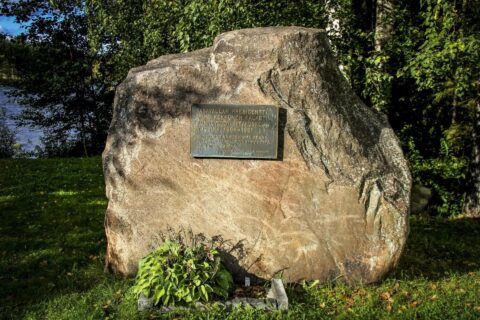
In the early 1990s, local heritage associations revived the old post, coaching and military road as a cultural route from Rautalampi to Kyyjärvi. In Konnevesi, the route includes sites such as Siikakoski and the Neituri Canal with its historic fortifications. A stone milestone was erected in front of Konnevesi’s municipal hall to mark the town’s place along the route, and the Pietari Brahe Road emblem was added in 2006, 220 years after the road’s completion. Today, the road is known as Kauppatie in the village centre, while the modern section from Hirvaskangas to Koskelo forms part of Highway 69.